

Where product data feeds are used
Product data feeds act as keywords in search engine product and vehicle listing ads. Anytime Google, or other search engines, displays a product ad, that ad is assembled using data like product image, price, URL, reviews, and more.
Search engines like Google Ads, but also Bing, Pinterest and others, match online searches and shopper interests to product ads based on words used to describe products. These words are contained in the product feed.
Product titles and product metadata, like size, color, condition, etc., are the words used by search engines to match their users’ queries and interests to the advertised products.
Google explains that…
Shopping ads use your existing Merchant Center product data (not keywords) to decide how and where to show your ads… We’ll use [Merchant Center data] details when we match a user’s search to your ads, making sure to show the most relevant products.
While Meta explains that…
Meta Advantage+ catalog ads automatically show people the most relevant products or services from your catalog based on their interests, intent and actions online.
Pinterest, Reddit and other ad platforms might not explain how they show product data ads to their users. But it’s certainly based on words that advertisers submit in their product data.
Product data in real-world Google Ads placements
Google’s shopping ads (product and vehicle ads) provide added benefits of showing your product inventory on diverse properties like Google Maps (shows customers product/vehicle availability and prices with location-based ads in Google Maps), YouTube, Gmail, and the Discover App.
The Discover App has 800M+ users as of 2018, and the remainder of Google’s products have enormous global user bases. A product data feed enables your ads across all Google properties, like YouTube and Gmail, and across numerous countries, like the USA, Europe and most of the web-connected world.
Use product data to sell more
If you’re selling replacement parts for industrial or vehicle applications, imagine the many different ways that someone might search for an item in your inventory. We’ll use this part as a small example.
A small example
Product data contained within your product feeds could include something as simple as “what this product is? It is a pair of shoes” to “does it fit my 2016 Subaru? Yes, it is compatible with 2014–2018 Subaru Imprezas.”
Google, and other ad platforms, know the answers to the above questions based on a lot of data you’ll input into your data feeds. Here’s a few examples below.
Google could match any of these searches to this product:
A/C Compressor - 2015-2019 Subaru WRX STI 2.5L H4
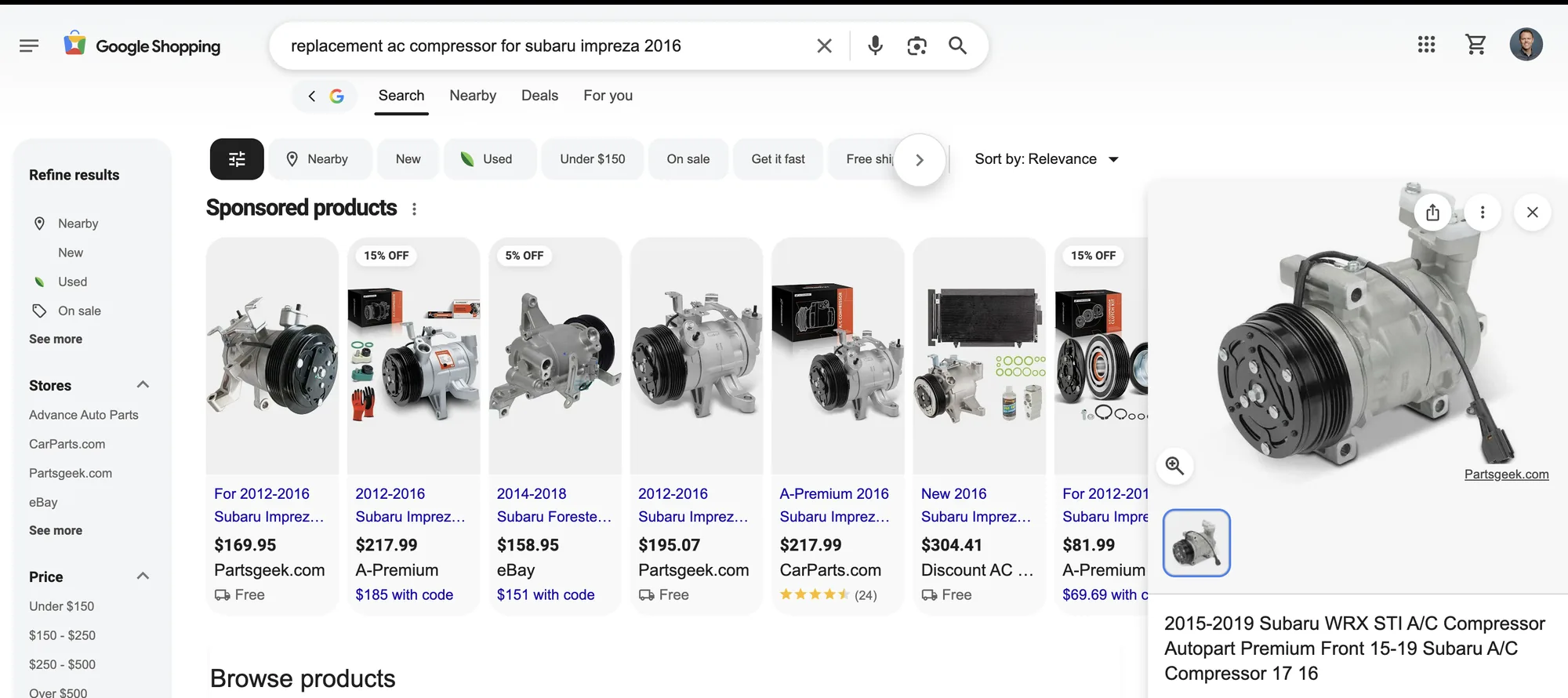
See how searches match your product feed
Click a sample search to see which feed attributes Google could use to match your product. Matching fields highlight in the feed panel, and the Shopping ads that fit the search brighten on the right.
Sample searches
Tap a sample search or a shopping ad to preview a match.
Other data
There are over 100 attributes that you might add to a data feed. Beyond titles, products include data like product_type, condition, availability, and many more fields that describe each SKU.
Here is a great guide by Emmanuel Flossie at FeedArmy: These 8 Feed Attributes Directly Impact AI Overviews. Full Breakdown with Examples.